Wall Street closes at a record for the first time since end of January
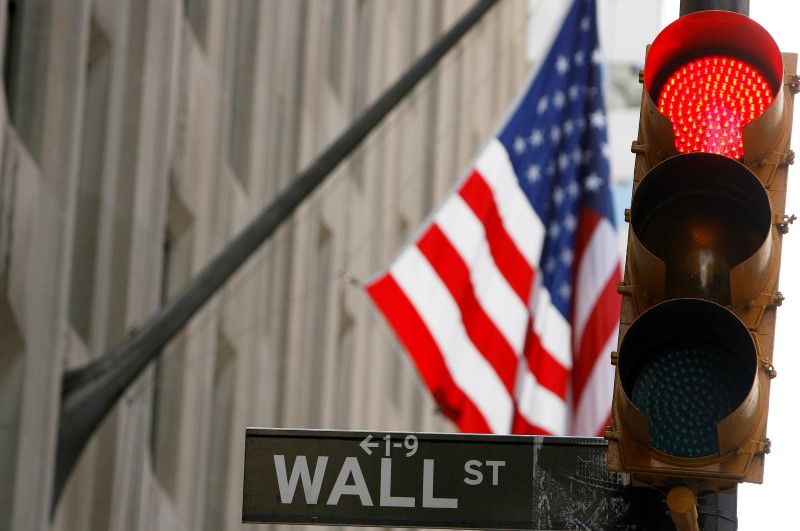
Investing.com -- Wall Street on Monday ended 1% higher in a solid rebound from a negative open, helped by a rebound in software stocks, a shift in focus to the start of the earnings season, and hopes that U.S. and Iran negotiations would continue despite failed weekend talks.
President Donald Trump said a U.S. navy blockade on the Strait of Hormuz had officially started, though he also touted the "highest number" of shipping traffic transiting the critical waterway on Sunday.
The S&P 500 improved 1% to close at 6,887.00 points, and with the gain the benchmark index has now erased all losses since the Middle East conflict began. The tech-heavy NASDAQ Composite added 1.2% to settle at 23,183.74 points, reversing a fall of as much as 0.5% earlier in the session. The blue-chip Dow Jones Industrial Average climbed 0.6% to conclude at 48,219.05 points.
"Despite the headlines, markets are showing resilience. Investors still appear to view negotiations as a viable path forward, which has helped calm oil prices. At the same time, earnings are coming back into focus as the primary driver of this bull market, particularly within technology and AI related themes, which represent the largest share of the S&P 500 and continue to show constructive action," Keith Lerner, chief investment officer and chief market strategist at Truist, told Investing.com.
Wall Street coming off a 3% weekly gain
The main averages on Wall Street closed in mixed fashion on Friday, as caution took hold ahead of the crunch negotiations between Washington and Tehran in Pakistan. A temporary two-week ceasefire was announced last week, although it remains uncertain whether the fragile deal will lead to a permanent end to hostilities.
However, the announcement of the ceasefire sent risk appetite soaring for a second week in a row, with the S&P 500 jumping 3.6% and the Nasdaq soaring 4.7% for the week.
The mood was dampened somewhat on Friday after data showed a surge in consumer prices in March largely due to a jump in gasoline pump costs due to a war-induced energy shock. The index for energy-related prices notched its biggest monthly gain since September 2005.
Oil prices have spiked since the start of the Iran conflict in late February, driven by an effective closure of tanker traffic through the Strait of Hormuz, a narrow waterway off of Iran’s southern coast through which roughly a fifth of the world’s oil squeezes.
Trump orders Hormuz blockade after weekend talks fail
Trump on Monday said a blockade to prevent ships from entering or exiting the strait had gone into effect at 10:00 ET.
Trump later said 34 ships had gone through the strait on Sunday, adding it was "by far the highest number since this foolish closure began."
"We can’t let a country blackmail or extort the world because that’s what they’re doing, they’re really blackmailing the world. We’re not going to let that happen," the president told reporters.
"And many ships are heading to our country right now as we speak to load up with the best [oil]," he added.
The president first announced the blockade on Sunday, warning that no ship who has paid an effective toll charged by Tehran will have "safe passage on the high seas."
However, a statement from the Pentagon later noted that while any ships "entering or departing Iranian ports or coastal areas" will be blocked, other boats will be allowed to traverse the strait.
The developments came after the U.S. and Iran finished 21 hours of negotiations in Pakistan without an agreement to solidify an ongoing two-week halt to hostilities.
U.S. Vice President JD Vance, who led the American delegation during the discussions, said Iran had refused to accept U.S. demands to refrain from developing a nuclear weapon. Iran did not immediately provide a comment on the talks, although Pakistan -- which has served as a mediator -- stressed that both sides must "uphold their commitment to ceasefire."
Oil climbs back above $100 a barrel
Oil prices sharply pared gains on Monday, pulling back from the $100 a barrel level, after Trump’s post about the 34 ships transiting the Strait of Hormuz.
Brent oil futures were last up 3.2% to $98.26 a barrel. U.S. West Texas Intermediate crude futures, meanwhile, added 1.4% to $97.94 a barrel.
Despite the climb, analysts at Pepperstone suggested that the market reaction to news of a U.S. blockade had been "relatively contained," as market participants "view the move largely as a negotiating gambit" from Trump.
"While it’s clearly a risk-averse start to the trading week, amid President Trump’s announcement of a Navy blockade in the Strait of Hormuz, the general market reaction can be summed up as ‘could be worse’," said Michael Brown, senior research strategist at Pepperstone, in a note.
Following the initial announcement of the ceasefire last week, which itself came after Trump threatened to destroy all of Iranian "civilization" should the Strait of Hormuz not be reopened, crude prices fell below $100 a barrel. Still, oil hovered well above pre-war levels.
Trump on Monday, when asked what would happen if a deal with Iran was not reached by the end of the ceasefire period, said "I don’t want to comment on that, but it won’t be pleasant for them, let me put it that way."
The oil price increase caused by the widening conflict in the Middle East has underpinned worries around a possible spike in inflationary pressures around the world. On Friday, data showed that U.S. consumer price growth sharply accelerated in March, due largely to a war-induced jump in gasoline pump costs.
Although underlying figures stripping out fuel and food were more mild, the prospect of oil prices remaining well above pre-war levels -- and pushing up inflation in the process -- for a protracted period have led some investors scale back bets that the Fed will slash interest rates in 2026.
Rate cut bets have fluctuated on Monday, with the CME FedWatch tool showing a 27% chance of a 25 basis point rate cut in December. That figure was 16% earlier in the day, and 21% the day before.
Goldman Sachs kicks off bank earnings on a disappointing note
Earnings from major Wall Street banks will be in focus this week, beginning with quarterly results from Goldman Sachs.
The Dow 30 component reported a 19% jump in Q1 profit, thanks to robust volatile markets which underpinned a record three-month period at its trading and banking units.
Dealmaking activity, buoyed by a resilient economy and massive investments in artificial intelligence infrastructure, also aided results. Overall, the quarter was Goldman’s second-best ever for profit and revenue, behind results in Q1 2021 that were powered by a COVID-era rebound.
But investors were unhappy with the bank’s results in its fixed income, currencies, and commodities segment, sending its shares down 1.9%.
"Portfolio juggling helped deliver a record quarter for the bank’s equities trading division, but disappointing numbers from the fixed income business appeared to be the key takeaway for investors," Danni Hewson, head of financial analysis at AJ Bell, said.
Other major banks due to report this week include JPMorgan (NYSE:JPM), Wells Fargo (NYSE:WFC), Citigroup (NYSE:C), Bank of America (NYSE:BAC), and Morgan Stanley (NYSE:MS).
In other moves, software stocks rebounded after three straight sessions of losses. The space was under pressure due to concerns over disruptions from AI advancements, especially Anthropic’s "Claude Mythos" model. The iShares Expanded Tech-Software Sector ETF (NYSE:IGV) rose 5.4%, its best daily gain in just over a year.
Ambar Warrick and Scott Kanowsky contributed to this article